Tuesday, July 17, 2018

Our Four-Generation Photos

From the time she was little, our daughter wished for a daughter of her own, a wish that found fulfillment this spring. Along with that wish came her desire for a four-generation picture. She wanted to get her beloved Grammie (my mother, Anonna Hubbard), in a photo with me, herself, and her daughter.

When Macy was born in April, our daughter began planning for that picture she had always wanted, but she was living in Washington, my mother was living in northern Utah, and I was in Arizona, serving a full-time Mormon mission. The picture seemed unlikely.

Last month, a series of unexpected (and frequently unfortunate) events sent my husband and me to northern Utah on medical leave. He needed a procedure to correct an irregular heart rhythm. That gave me the opportunity to visit my 93-year-old mother, an opportunity I hadn't expected to have for another year.

Elder Aylworth had his heart procedure, but a series of unexpected complications kept us in the area for a week longer than we anticipated. That week became a huge blessing. 

Two days before we left on our Utah trip, my mother fell and broke her arm. Because it could not be immobilized (and, at 93, she was not a candidate for surgery), every motion was agonizing. A week later, and the day before my husband's surgery, my mother went on hospice. Again, it seemed unlikely that a four-generation picture would ever happen.

In a coincidence of timing that can only be considered providential, our son-in-law accepted a new job within 40 minutes' drive of where my mother was living. On Sunday, July 1, my daughter and her daughter arrived at my mother's apartment. Mom was in a hospital gown with her arm in a sling, but the four-generation pictures finally happened.


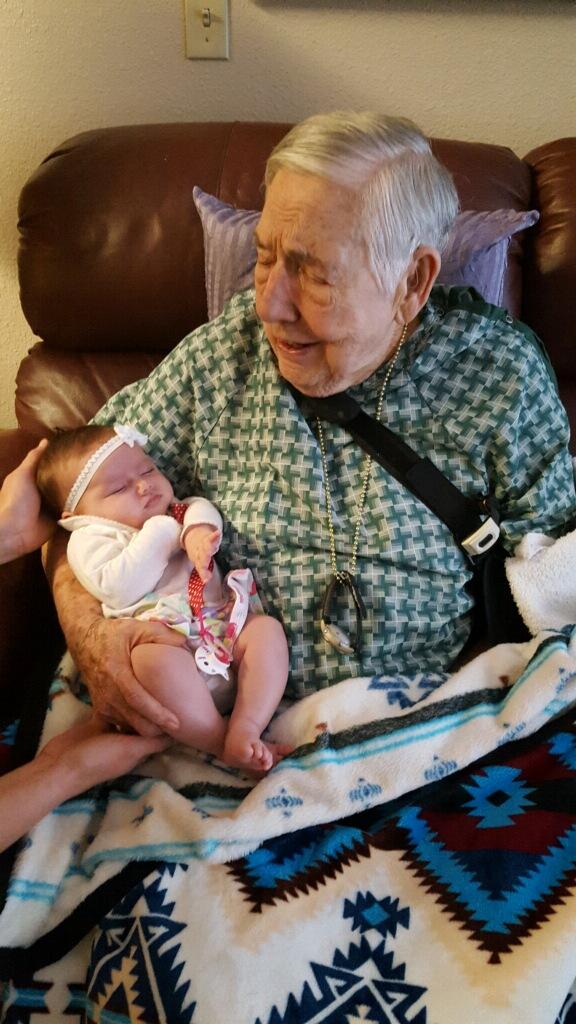
On that Sunday, my mother was clear and cogent. Blinded by macular degeneration, she couldn't see us, but she could hold the baby, touch her, comment on her long, strong fingers and long, thin toes, and share the wonder of new life with all of us. Only two days later, my mother was gone.

These last two pictures show our daughter crying happy tears, grateful for the small miracles that made her visit and these pictures possible, and my mother, enjoying holding her great-granddaughter.


I will forever be grateful to my daughter for the effort she made to arrive "on time," to my mother for hanging on the way she did, and to my sweet sister, who took these precious pictures. Our four-generation photos may not be ideal, but we will treasure them as we treasure the memories of this last four-generation visit.

Saturday, July 14, 2018

Watching the Tour de France

by Karen McCullough

Years ago our son got me and my husband hooked on the Tour de France. I started watching it mostly for the gorgeous pictures of the French countryside, the chateaux, the cathedrals, and castles that were featured to accompany the race. The bicycling itself didn’t interest me. But I gradually was sucked into the intricacies of the race itself, which proved to be fascinating.


Prior to this I knew the Tour de France existed and heard about it occasionally. But it sounded ultimately boring. A lot of cyclists racing around the country. Whole lot of pedaling. Yawn.

There are long stretches that are fairly boring, too. That’s one of the reasons you get all these lovely views of the countryside and sites of historical or esthetic interest. They do need something to fill in some of the time.


(By the way, all images here are from my television screen.)

Like a lot of things that appear simple on the surface, however, cycle racing is much more complex than it appears at first sight. There are a lot of things going on and it’s been fascinating to learn about some of them.

These are just some random thoughts about the Tour de France:

Grand tour racing is a team sport. (The Tour de France is the best known of three Grand Tour races – those that are 21 days long and include a variety of types of courses.) A single rider cannot hope to win one without a huge support staff, including team-mates riding with him. Although teams may come into the race with different goals, most teams have a single intent and build their team around it.


A good part of the team advantage grows out of one simple principle of aerodynamics. Because a rider can ‘draft’ off other riders, maintaining the same speed without having to do the same amount of work as the person in the lead, a group working together can generate more power for a much longer time than a single rider on his own.

There are races within the races within the races. Of course, there is only one overall winner, but there are other prizes available. The overall winner gets a yellow jersey, but there is also a green jersey for the best sprinter, a polka dotted jersey for the best mountain climber, and a white jersey for the best young rider. Each stage has its own winner as well, and those are coveted prizes.


The race is set up to test different skills. Some stages are long and relatively flat, while some are brutally mountainous. The idea is that the overall winner has to be good at all those things. Riders who are trying to win the whole thing are called “GC” (General Classification) contenders. But some teams bring a specialist in either sprinting or mountain climbing to the race and concentrate all their efforts toward winning those competitions.

The long and relatively flat sections of the race normally end with a furious, all-out sprint for the finish by riders who specialize in just that. They’re racing for the stage win, but also points are awarded to the top ten or fifteen finishing positions and the total of those points decides the green jersey competition. Some stages also have “sprint points” within the course that award points to the first few people across that line.

Probably the most brutal stages are those that include several long mountain climbs and the even more terrifying long, winding descents most riders take at speeds that wouldn’t be wise in an automobile, let alone on a bicycle.

There are also stages that are just time trials, where riders race against the clock rather than each other.

Unexpected things can always occur. On a long flat stage, a crosswind can play havoc with the peloton. The bicycles are complex, finely-tuned instruments and they sometimes break. Flat tires are common. Chains sometimes come off the gears. Teams are set up to respond quickly to these, but it can still cost a rider time, especially if it occurs near the end of the stage.

Crashes happen. At least some of the race is on narrow roads. Sharp bends and the frequent roundabouts of European roads can create havoc. The competitors tend to ride bunched tightly together so they sometimes just run out of road space. And when one goes down he usually takes several more with him.

Not all the riders who start the race can finish. Some become ill during the race, but most withdrawals are the result of injuries suffered during crashes.

Although tactics plays a huge role in how the race plays out, the amount of courage, strength, stamina, and sheer guts all the riders need to compete is almost beyond imagining.


Thursday, July 5, 2018

Taking Stock of Your Writing


by Victoria M. Johnson

If you piled all your writings together in one place how much room would you need?  A shelf, a closet, or an entire attic?  Think about all your journals filled with your poetry or musings, all your novel manuscripts, and maybe even published books.  How much space do they take?  It may be an eye-opening experience to give it a try. 

Photo by Simson Petrol

I had the opportunity to do this taking stock (by accident) when we moved to a larger home.  I only meant to shelve things so my office wouldn't be cluttered, but by sorting all my writings into a huge closet in my office, I learned a few things.
 

1.  I had written a lot of words.

There was a lot of work stuffed in that closet and I felt a sense of pride that I was doing what writers are supposed to do.  I was producing words, thoughts, and stories.

2.  I submitted a very small percentage of the words I wrote.

I was stunned that I hardly ever submitted most of the work filling that closet.  That is a weakness that I need to fix.  Writers write, but they also submit.

3.  I write in many different forms.

For someone who thought of herself as an aspiring novelist, it surprised me that I had completed more screenplays than novel manuscripts.  Nowadays I'm writing a lot of poetry, too.

4.  I need to purge some of this.

The biggest discovery from this exercise was the amount of paper—old drafts, manuscripts I'll never submit, and other stuff that I don't need anymore—still taking up my space.  The journals I plan to keep forever, I find good material in them.  But stories that I have no intention of revising… those should go, right?  How much of my previous writing do I really need to hang onto?  How do you manage the paper?  Let us know in the comments.  Also, if you do take a picture of your writings, please post it and share the link.

Victoria M. Johnson knew by the time she was ten that she wanted to be a writer.  She loves telling stories and she's happiest when creating new characters and new plots.  Avalon Books and Montlake Romance published Victoria's fiction debut, The Doctor’s Dilemma.  Her other fiction book is a collection of romance short stories titled, The Substitute Bride and a novella, Hot Hawaiian Christmas. She is also the writer and director of four short films and two micro documentaries.   Visit Victoria's website at http://VictoriaMJohnson.com for inspiration and tips and find her Amazon author page or connect with her on Pinterest and Twitter.

Monday, July 2, 2018

Slothing, Deadlines and Retirement


by Janis Susan May/Janis Patterson

I've always been a writer. I went to work for my parents' advertising agency before I was out of elementary school. I sold my first novel in 1979. I'm even one of the 40 or so women who founded RWA in 1980. I have been Editor in Chief of two multi-magazine publishing groups. Last year I wrote five novels.

As I've probably told you, during the last quarter of last year I had three surgeries - the first ones I've ever had. The first two went very well and recovery was speedy. Oh, don't get me wrong - the third one went better than could be expected, but had unintended consequences.

I had been told that I would be on strict bed rest for at least 8 days after the surgery, which didn't upset me at all. No distractions! I thought. I can spend all day writing without feeling guilty for not doing any housework.

Wrong. Oh, I had The Husband bring my computer on a bed tray and put it in the bed beside me. In case writing palled, I had the remote to the DVD player across the room, loaded with a movie I had requested. There were a couple of sodas, a full ice bucket and some tasty snacks by the bed. None of it made any difference - I didn't utilize any of them. I slept. I slept like a dead thing, barely waking to go to the bathroom - the only excursion I was allowed. For all 8 days.

At the end of my incarceration I was released to semi-invalidism; I could get up and move around the house, as long as I kept my foot (it was foot surgery) elevated. Now The Husband set up my typing table in front of the TV, I had the remote in hand and sodas and snacks beside me. Now I am awake, I thought, I can really get some good writing done.

Wrong again. I indulged in an orgy of mindless daytime TV and somehow managed to escape total brain death... but no writing got done. I even coined a new word for this strange lassitude - slothing - and have taken the sloth as my spirit animal.

Now it is 6 months later and I still have done very little writing, and a dreary sales record isn't helping. I haven't finished a single book so far - and I'd better get a wiggle on, because I have a deadline in early August, and I've never missed a deadline in my life. This lackadasicalness is very untypical of me; I've always loved writing and indulged in it every moment I could. Writing was my escape from a world that all too often unappealing.

Now, for the first time in my life, writing has become work, and that alarms me. I am of an age where retirement is expected, and even though I had never thought to retire from writing the idea is beginning to have its appeal. I am drawn to increasing the time spent on my political and social activism. I would like to do more work with my women's clubs and my scholarly Egyptological organization. And there are some bits of housekeeping that simply must be done! (I fully admit to lacking the housekeeping gene...) There are five full novels, all complete and edited, ready for cover and formatting and release, sitting metaphorically on my desk. (Actually they're on the computer, but you know what I mean.)

Perhaps part of my lassitude is brought on by the sudden and unexpected death of my dear friend and long-time cover artist Dawn Charles. A friend can never be replaced, but a cover artist not only can but must be... eventually. I've shied away from seeking covers for the simple reason that Dawn spoiled me - she 'got' what I wanted. After 20-odd covers, I just don't have the heart to start auditioning new artists right now.

So for now I am still working at working. I have contracts that must be fulfilled, and fulfilled they will be. Maybe by the time this contract is completed and I have found a new cover artist (those five novels deserve a better fate than being imprisoned forever in my computer) this cloud will have lifted from my spirit and I will be back in the saddle again, writing like a fiend and loving it. I kind of hope so.

Thursday, June 28, 2018

Sides of History

Quite often, we hear that someone or some idea is on the "right side of history." When I began talking about my project, Pavane for Miss Marcher, one of my fellow writers said, "Just make sure you stay on the 'right side of history'."

I knew exactly what she meant and the element of threat was blatant. Also obvious was the attempt to censor. Pavane for Miss Marcher is set in post-American Civil War Maine. I had read widely from all sides and aspects of this era in the history of the United States.

Although, like many Americans, I was very well aware of the heated emotions and often disputed facts of this period, I was determined to write the story I felt most clearly expressed my own ambiguous and conflicted  understanding of our shared history.

The main character is a young woman, Cathryn Marcher, who experiences the trauma and horror of the war while serving in a Union Army hospital in Boston. During her service, she becomes involved with an officer who takes advantage of her youth, loneliness and vulnerability. Their affair ends when he returns to his unit and the war comes to an end.

 Many years before, Cathryn had fallen in love with a young man from her town. Her service as a nurse was her contribution to the war, in hope that somehow Rupert Smith was being cared for by a good nurse wherever he was.

Rupert has spent the last year of the war in a prison camp. His courage and honor win him the respect of not only his fellow prisoners but also several of the Confederate soldiers who are assigned to guard the Union prisoners. When the war is declared to be at an end, Rupert is in no condition to return to his small town Maine home. The men from both sides of the conflict have formed a close bond that takes them West.

The encounter with the adamant writer actually sharpened my intention to write a story based on the realities of human interaction and the facts rather than take up camp on any side, right or wrong. In history, there is only one side: the truth with all its convolutions and contradictions.

This story has a happy ending which sometimes happens in life, despite the horror of war and the evil that surrounds us. When confronted by the demand that I "stay on the right side," I determined that I would: to write honestly about what I know.


Monday, June 25, 2018

Grammar and Usage Pet Peeves

We should be able to tell something about the speaker from a conversation. A person’s choice of words can be shorthand for characterization. In My Fair Lady, Professor Henry Higgins brags that he can tell from a person’s speech where they’re from, sometimes he can even pinpoint the exact address.

Although regional accents are fading, at least in the United States, one can still show who someone is by their words. If I had a character refer to their friend as their “bro,” you wouldn’t think the speaker was a middle-aged affluent woman.  You’d assume it was a guy, probably in his twenties.  

Similarly, if a character used the word awesome, you’d figure the speaker was either in his thirties or trying to appear younger than he is—which gives you a wholly different picture, but impression nonetheless.

Then there is usage that’s come into our language that isn’t necessarily correct or accurate but has been adopted by so many it’s become part of our language whether we like it or not.

“No problem,” is my candidate for an expression that doesn’t make sense. From the first time I heard “No problem,” said in response to a thank you, I hated it.  Even now, thirty years later, I have to bite my tongue to keep from saying, “who said there was a problem? I just said thank you!” 

But this is not the only one that bothers me. How about “he (or she or I or you) did good.” Am I the only one irritated by this bastardization? If I am, I imagine a time in the not too distant future where everyone will say, “he did good,” and I’ll be prim and proper old lady hanging on to an outdated concept.  Slowly but surely “he (and whoever else is to be included) did good,” has crept into our usage.

In closing, I should set the record straight before anyone thinks I’m the grammar police.  I’m so not by birth or family of origin or practice. My birth family was and is made up of avid and serious readers who pride themselves on their intellectualism but who play fast and loose with the objective case.  “Between you and I,” could have been said in my house growing up without offending anyone.  On the other hand, Dylan Thomas, Raymond Carver and Cormac McCarthy were all patron saints.

But I married into the Nolan family who, though not all readers (there are a few notable exceptions), were raised, from all accounts, by the grammar Gestapo.  Suffice to say that with my 40th wedding anniversary coming up this year, I’ve cleaned up my act.  But my husband and my critique partners will tell you, I still make plenty of mistakes.  But as it is true with religion, it is also true with grammar, “there’s no one more scrupulous than a convert.”

I assume that anyone reading this has their own grammatical and usage pet peeves and I would love to hear about them.

Tuesday, June 12, 2018

Sharing the Joy

by Sandy Cody

I once had the pleasure of interviewing Jane Hamilton (author of Book of Ruth and  A Map of the World, to name just a couple of her books). I asked her which part of writing she most enjoys. Here's her answer:

 HAMILTON:  I love it when, with some kind of magical harmonic convergence, everything starts to hum along, and you hardly know you yourself are present at work. (This is not a usual occurrence). It’s as if you’ve spun gold from straw; you look up and think, How did that happen? Also, I enjoy reading my work out loud to myself when it’s going well, when I can take pleasure in my own sentences and story.”

 I think one of the reasons Ms. Hamilton’s answer resonated so strongly with me was the contrast with some (most?) of the things I say when I talk about writing. I speak too often about the difficulty of writing and too seldom about the joy. I share those moments of inadequacy when the words won’t come and fail to mention the rush of joy when they do come, those all-too-rare moments when I feel that I've “spun gold from straw” or the pleasure of reading aloud a description or a bit of dialogue that got it right.


 Since I know a fair number of other writers, I know this is common. Writers complain a lot … about the loneliness of writing (then turn around and say we can’t write because no one will leave us alone); about the discipline required (as if anything worth doing doesn’t require discipline); about the lack of time to write (which might be less of a problem if we’d stop complaining and just write); about the demanding people in our lives (what would we write about if we didn’t have them?).

Why do we do this? I’m not sure. I think it’s at least in part because we’re obsessed with writing and don’t know how else to talk about it–possibly due to a misplaced sense of modesty. We’ve been taught that it’s not nice to brag. Fair enough. But is it any nicer to subject those around us to a litany of imagined woe when, in fact, we’re doing what we love? Granted, realization of the pain of writing is a necessary part of birthing a novel, but maybe we need to lighten up and broadcast the pleasures of our chosen vocation. Let’s share the joy.

So ... here I am ... saying it out loud. I am a writer and that is a privilege and a joy. I am living my dream.